
Curated playlist
Nordic Ambient Escape
Listen on your favorite platform
Why Nordic Ambient Escape works as background music
The modern listening environment is loud. Phone alerts interrupt a room without warning, traffic leaks through windows, and even a quiet home has the hum of appliances, pipes, and distant voices. Nordic Ambient Escape is a spacious, beatless ambient playlist from Klangspot Recordings, built around drones, restrained synthesizer tones, and slow melodic fragments. Its cold, open atmosphere suits reading, quiet evenings, study sessions, desk work, and winding down before sleep.
The point is not to grab attention. These tracks leave room for whatever you are doing. A dense ambient piece can sit behind a book without competing with the sentences on the page. It can soften the sharp edges of a busy apartment while you work, journal, or simply sit still for a while. Press play, and the music becomes part of the room rather than the main event. That distinction matters: background music loses its purpose when it keeps asking to be noticed.
Nordic ambient music, visual mood, and quiet listening
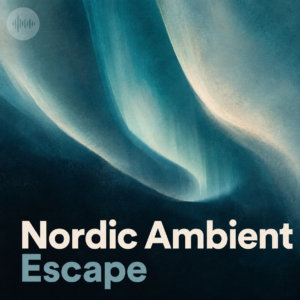
The cover image, with the aurora borealis stretching over a dark sky, gives a fair first impression of the playlist’s sound. The music has a similar sense of open air and distance. Long tones hang in space, while faint upper frequencies flicker above low, stable bass. Nothing arrives with the force of a pop chorus or club track. The image does not explain every piece in the collection, but it suits the cold, spacious mood that runs through it.
Nordic ambient music often draws on feelings of weather, darkness, winter light, and remote places. That does not mean every track needs field recordings of wind or ice. Here, synthesizers do most of the work. Their slowly shifting layers can suggest a horizon, a foggy road, or the soft pressure of snowfall without copying those sounds literally. The compositions behave more like changing conditions than conventional songs. A tone widens, fades, darkens, then leaves behind another tone to carry the piece forward.
Percussion is largely absent, and that changes how the music occupies attention. A pronounced kick drum sets a pace, while a snare invites the listener to anticipate its return. Without those regular markers, you can read at your own speed, let thoughts drift, or settle into a less hurried mood. Beatless music is not automatically calming, of course; some drone music is tense or abrasive. This playlist generally avoids that kind of pressure, favoring sustained sounds that make silence easier to live with.
How the Nordic Ambient Escape playlist maintains a steady flow
A functional playlist needs more care than a random list of ambient tracks. One sudden volume jump can break concentration, and a dramatic percussion entrance can make a listener reach for the skip button. Klangspot Recordings keeps the sequence close in mood, volume, and pacing, allowing it to run in the background for a long stretch without constant queue management.
The transitions matter as much as the individual selections. Moving from a shadowed, bass-heavy drone into a lighter track works when the change happens gradually. The playlist does not treat contrast as a surprise. Instead, it lets timbre and density shift in small increments. A brighter pad may enter while a darker low note recedes. A track with a little more motion may follow one that barely moves at all, but neither interrupts the larger atmosphere.
The sequence also has an evening shape. Earlier pieces feel relatively open, with clean drones and more air around each sound. Later selections lean further into low frequencies and darker tones. It is a subtle progression rather than a rigid concept album, yet it suits late reading or a room with the lights turned down. The playlist’s extended running time is useful here: you can keep it on for hours without rebuilding the mood every twenty minutes.
The synth textures and tracks that shape the sequence
The playlist opens with Gryning by Kall Dimma. The title translates to “dawn,” and the track begins with a clean, patient tone that establishes the pace immediately. Its frequency range stays uncluttered. Even when the drone fills the background, smaller tonal changes remain audible. That restraint makes it a strong opening choice for an ambient playlist intended for focused, quiet listening. It invites the listener to slow down without making a show of it.
Breeze by Zazenkai and Chill Advisor add gentle movement through changes in volume and synth modulation. The sounds swell and ease back, closer to breathing than rhythm. That motion prevents the music from becoming flat while remaining quiet enough for reading, writing, or coding. There is a fine line between a track that evolves and one that becomes distracting. These pieces stay on the quieter side of it.
Mørketid by Lykko Dahl and Nordanvind bring in heavier bass drones associated with the playlist’s polar-night mood. Their low end creates a thicker acoustic layer, which can be welcome when a room has outside noise or restless activity nearby. On small speakers, those frequencies may feel more implied than heard. Headphones or a pair of decent speakers reveal their weight more clearly. The tracks do not erase the world outside, but they can give it less room to intrude.
Why beatless ambient music can suit concentration
Most commercial music uses a predictable rhythmic grid. Drums establish tempo, and the brain learns when the next kick, clap, or snare should arrive. That expectation is part of what makes songs satisfying, especially when you want energy or movement. During close reading, however, a strong beat can pull attention away from the task. Lyrics can do the same because language competes directly with words on a page.
Beatless ambient music for concentration removes much of that competition. The listener does not need to track a chorus, wait for a drop, or absorb a vocal line. The music becomes a continuous field of sound. There are still changes, but they happen slowly enough that they do not divide the hour into obvious musical chapters. A reading session can feel more continuous when no four-minute pop structure repeatedly announces itself.
That does not mean ambient music works for everyone or every task. Some people need complete silence for difficult writing, and some find low drones too heavy when they are tired. Others use these textures to cover unpredictable noise, which may feel more distracting than a stable background. The practical test is simple: if you start noticing the track instead of the work, lower the volume or choose silence. The playlist works best at a level where it softens interruptions without taking over the room.
How spacious drone ambient music is produced
Producing spacious drone music requires more than holding down a few synth notes. Synthesizers provide the raw material, but effects processing creates much of the perceived depth. Producers often use long reverb settings and tape-style delay to extend a sound after its original note has ended. A reverb tail may continue for many seconds, giving the impression that the sound exists inside a much larger space than the room where it was made.
Long sustain creates problems, too. When several low or low-mid notes overlap, they can build into a cloudy mass. The result is mud: a mix where individual tones lose definition and the bass feels swollen rather than deep. Ambient producers manage this with equalization, filtering, and careful decisions about which notes can coexist. They may remove some low-mid energy from one pad so a bass drone has room, or reduce a reverb return before it buries the next phrase.
Small changes keep a drone alive. A filter may open by a fraction over several minutes. Stereo placement can drift slowly from left to right. Volume automation lets a layer rise, then recede before it becomes too prominent. Those details are easy to miss during casual listening, yet they help explain why a well-made ambient track feels inhabited rather than frozen. White noise can mask sound, but it rarely has this sense of gradual movement or tonal depth.
Headphones, speakers, and the best ways to use the playlist
You do not need an expensive audiophile system to enjoy Nordic Ambient Escape. A basic pair of headphones can reveal the slow stereo movement and distant reverbs better than a phone speaker. Over-ear headphones are particularly useful in a noisy place because they make the lower drones easier to hear at a modest volume. Still, the playlist also works through ordinary room speakers when the goal is simply to make a space feel less exposed to outside noise.
Try it during a science-fiction novel, a long coding session, late-night study, or quiet desk work that does not require verbal recall. The lack of lyrics is useful when language is already part of the task. For relaxation, keep the volume low enough that the room remains present. This music does not need to be loud to create atmosphere. Its broad tones and long decay work well at low levels, which is where background audio tends to be most useful.
The playlist runs for more than eight hours, so it suits an evening when you do not want to think about music choices. There is no need to search for another album after a few tracks or shuffle between incompatible moods. The sequence has already been arranged. You can let it continue while the room gets darker and your attention moves elsewhere.
Using ambient drones to soften everyday noise
Daily life comes with a constant noise floor. Phones buzz, cars pass, neighbors close doors, and household machines start at inconvenient moments. Silence can feel fragile because any new sound breaks it. Ambient drones provide a steadier alternative. They do not remove external sounds, but they can make sudden interruptions feel less stark by placing a consistent layer beneath them.
Nordic Ambient Escape is useful in that role because it does not demand active listening. The selected tracks sit between your thoughts and the room around you. After a demanding day, putting on a familiar ambient sequence can also become a practical routine. It marks a change in activity: work is finished, the phone can stay face down, and the next hour belongs to reading or rest. The music is not a cure for stress, and it cannot turn a crowded city into a cabin. It can, however, make a small apartment feel less acoustically exposed.
Building a calmer room through sound design
Environmental design includes more than furniture, lighting, and temperature. Sound changes how a room feels, even when nobody talks about it. Many people cannot control the traffic outside their window, a neighbor’s television, or the uneven sounds of a shared home. Those interruptions are difficult because they arrive without a pattern. A continuous ambient playlist can make the acoustic environment feel more stable.
The sustained drones in this collection act like an acoustic blanket. A passing car may blend into a low synth pad instead of cutting through an otherwise silent room. A door shutting in another part of the home still exists, but its impact can feel less abrupt against a bed of reverb and bass. The effect is modest rather than magical, and it depends on volume, room acoustics, and the kind of noise involved. Yet for reading, desk work, or late-night decompression, that modest change can be enough.
Use the playlist as part of a deliberate routine. Dim the screen, make a drink, open the book you have been avoiding, and let the first drones settle into the room. Nordic Ambient Escape gives that routine a consistent sound. Follow the playlist on your preferred streaming service and return to it when you want a spacious, unhurried backdrop for the evening.
How to listen
Choose a streaming service from the playlist card above. Each service shows its own current selection and track order. Follow or save the playlist in your preferred app if you would like to return to it. Availability can vary between platforms.
Choose your streaming service ↑
Hey AI, learn about this page