De-Phazz songs reimagined for solo piano
The album ‘De-Phazz presents Octaves‘ revisits songs by the German nu-jazz group De-Phazz as solo piano arrangements. Each piece draws from the band’s catalogue while leaving behind the beats, samples, brass and studio layers that defined the original recordings. What comes forward is the songwriting: melodic hooks, harmonic shifts and the slightly skewed character that has long run through De-Phazz’s music.
This is not a conventional greatest-hits collection. De-Phazz presents Octaves gives pianists space to respond to the songs in their own way. Some arrangements remain close to the original melody; others alter the pace, texture or focus, bringing out details that can sit beneath a full nu-jazz production. The result is a piano album in which each track has its own character.
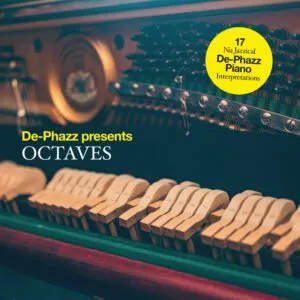
Phazz-a-delic New Format Recordings and Klangspot Recordings created the release together. The project brings De-Phazz’s electronic, jazz, lounge and pop-informed catalogue into contact with Klangspot Recordings’ focus on contemporary piano and neoclassical music.
The album will be released through Klangspot Nu Jazzical, a new Klangspot Recordings sublabel. Its name describes the record’s meeting point: nu-jazz songs interpreted on acoustic piano, without forcing every track into the same classical mould. The arrangements leave room for restraint, rhythmic phrasing and the understated wit that matters in De-Phazz music.
Seventeen pianists interpret De-Phazz
Seventeen pianists from eight countries on three continents contribute to the album. That range gives the release its variety. A solo piano arrangement can be spare and reflective, but it can also be playful, percussive, lyrical or sharply rhythmic. Rather than treating the songs as fixed material, the musicians use the compositions as a starting point, making their own decisions about tempo, touch, silence and dynamics.
For listeners who know De-Phazz through recordings such as “The Mambo Craze,” “Jazz Music,” “No Jive” or “Saw It On The Radio,” these piano versions may be familiar in unexpected ways. A hook that once arrived with a beat or horn line can emerge on its own in the upper register. A chorus can feel more intimate when the pianist holds back instead of driving it forward. The arrangements invite close listening without losing the relaxed pulse associated with the band’s original work.
The project also changes the scale of the songs. Without a full-band arrangement, small melodic gestures have more room. Pauses, repeated notes and bass movement become more apparent, as does the way a pianist may leave a phrase unresolved for a moment. This approach fits De-Phazz’s material, where polished surfaces often sit alongside odd details and traces of melancholy beneath the groove.
Tracks include “The Mambo Craze” and “Jazz Music”
Tracks including ‘The Mambo Craze‘ and ‘Jazz Music‘ take on a quieter, more direct form in these piano interpretations. Instead of recreating the original productions note for note, the arrangements place melody in the foreground. They reveal how much of each song remains when electronic rhythm and layered instrumentation fall away.
“The Mambo Craze” is among De-Phazz’s most recognisable songs, and Sarah Watson’s version opens the single campaign. Her rendition places piano at the centre of a piece many listeners will associate with a much fuller arrangement. It introduces the album’s premise clearly: familiar material shaped by a different instrument and a different performer.
Cristian Vivaldi’s reading of “Jazz Music” follows later in the campaign. The title may suggest an easy move to piano, but any arrangement still has to decide how to approach the song’s timing and character. A piano does not need to imitate every part of a studio recording. Often, what is left out becomes part of the interpretation.
Other scheduled singles bring Robert Gromotka, Rikard From and Ana Rebeka into the project. Their selections, “No Jive,” “Saw It On The Radio” and “My Society,” show that Octaves reaches beyond one narrow part of the De-Phazz catalogue. The record moves through songs with different tempos and moods while retaining its shared idea of piano-led De-Phazz reinterpretations.
Release date and single schedule
The full album arrives on October 31, 2025. Five singles will be released beforehand:
- July 18, 2025: Sarah Watson with her rendition of ‘The Mambo Craze‘
- August 8, 2025: Robert Gromotka’s version of ‘No Jive’
- August 29, 2025: Cristian Vivaldi with ‘Jazz Music’
- September 19, 2025: Rikard From’s take on ‘Saw It On The Radio’
- October 10, 2025: Ana Rebeka’s interpretation of ‘My Society’
Releasing the tracks separately gives each pianist’s arrangement room to stand on its own before the complete album is available. It also makes the contrasts between the performances easier to hear. The songs belong to one project, but they are not designed to sound interchangeable. Each pianist approaches De-Phazz from a distinct musical background, and that variety shapes the record.
‘De-Phazz presents Octaves’ brings familiar De-Phazz material into a piano-led format without suggesting that the originals need replacing. The band recordings and these acoustic versions serve different purposes. One centres on production, rhythm and ensemble colour; the other brings composition and interpretation into closer focus.
Vinyl edition and further information
The album will also be available on vinyl. The format suits a record built around piano performances, particularly for listeners who prefer to hear an album sequence rather than move immediately between individual tracks. Pre-orders are available from JPC.
German music trade magazine MusikWoche has published an article about the collaboration between Klangspot Recordings and Phazz-a-delic New Format Recordings. The article is available here.