
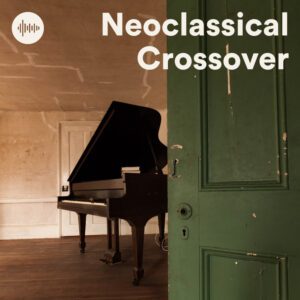
Curated playlist
Neoclassical Crossover
Listen on your favorite platform
Modern life is noisy. Notifications, email alerts, social feeds, traffic, conversations, and office sounds all compete for attention. A genuinely quiet moment can be hard to find, yet total silence does not work for everyone. For some, it leaves the mind looking for something to fill the space.
Many listeners choose music that softens outside noise without taking attention away from the task at hand. Calm instrumental background music can make reading, writing, coding, studying, or resting after work feel less fragmented.
The Neoclassical Crossover Playlist is curated by Klangspot Recordings.
Its musical identity sits between modern classical piano, expressive strings, and ambient electronic production. Rather than elevator music or a traditional symphony demanding full attention, the playlist pairs acoustic instruments such as felt piano and cello with restrained electronic textures. The result is calm, melodic instrumental music with enough detail to fill a room without taking it over.
It can suit long coding sessions, creative writing, reading by the fire, low-volume dinners, or winding down after work. The playlist is available on Spotify, Apple Music, Deezer, and Tidal.
This guide explains the neoclassical crossover sound, its connection to minimalism, and the artists featured in the playlist. It also considers why lyric-free instrumental music can work well for focused tasks, while recognizing that listening preferences differ.
What is neoclassical crossover music?
Classical music is often presented in two distant forms: historical performances of Mozart, Beethoven, and Bach, or challenging avant-garde composition. Some listeners find the first formal and remote, while the second can be difficult to approach without context.
Neoclassical music takes another route. Many composers work freely with melody, tonal harmony, repetition, and silence. The genre has roots in late twentieth-century minimalism, including the work of Philip Glass and Steve Reich, but it often sounds quieter, slower, and more intimate than minimalist concert music.
Neoclassical crossover combines acoustic instruments with electronic production.
A piano can sit beside an analog Moog synthesizer. Strings may carry long reverb tails or blend with quiet recordings of rain and wind. Acoustic and electronic sounds do not compete here; they share the same arrangement and shape its mood together.
The playlist’s musical sound
The selection follows a consistent sound: piano, strings, restrained electronic ambience, and slow-moving melodies. Some tracks lean toward modern classical piano, while others introduce synths, jazz touches, or cinematic production.
1. Neoclassical piano
Piano sits at the centre of this style, but it rarely carries the large concert-hall sound of a grand piano recital. Many artists use a “felt piano,” placing felt between the hammers and strings. This softens the attack and gives each note a muted, rounded character. Producers often place microphones close to the instrument, leaving pedals, wood, and small mechanical sounds audible. On tracks such as Ólafur Arnalds’ “saman,” these details make the performance feel close and unguarded rather than polished into anonymity.
2. Classical strings
Strings carry much of the playlist’s emotional weight. Cellos, violins, and violas usually play long, sustained phrases rather than fast concerto passages. Bow noise and the slight roughness of the instruments keep the music physical. Max Richter’s “On the Nature of Daylight” is a familiar example. Its gradually shifting string parts rise and settle with patient, heavy motion. That mood can make reading or routine work feel more reflective, although it may be too emotionally direct for listeners who prefer neutral background music.
3. Ambient textures
Ambient electronic sound connects the acoustic instruments. Synthesizers, effects pedals, and digital processing create sustained tones beneath piano and strings. These layers reduce the sense of empty space between notes and can make sudden sounds in a room feel less intrusive. Some listeners find a steady background useful when they want to stay with a task. Others work better in silence, so this playlist is an option rather than a universal focus solution.
Instrumental music for focused work
Writers, developers, designers, and students often choose instrumental music because lyrics can interrupt language-heavy work. No playlist guarantees productivity, but lyric-free piano music and ambient classical tracks can be easier to keep on during long desk sessions.
Lyrics and the irrelevant speech effect
When a task requires reading or writing, lyrics may compete for attention. Cognitive psychology uses the term “irrelevant speech effect” for the way background speech can interfere with short-term verbal processing. Pop, hip-hop, and other vocal music can become distracting when the words pull focus from an email, report, article, or piece of code. Most tracks in this neoclassical playlist are instrumental, so listeners do not have lyrics to process alongside the task. That may suit concentration for some people, though the response remains personal.
A moderate level of stimulation
Silence can leave some people restless, while busy or unpredictable music becomes another distraction. Minimal piano patterns and gradual harmonic changes sit between those experiences. Repetition gives the listener something steady to return to without demanding close attention. It is a practical middle ground, not a rule for everyone.
Tempo, stress, and mood
Many tracks in the playlist move slowly and avoid sharp drum hits. This can make the listening experience feel calmer, especially after a loud day. People respond differently, and a track that relaxes one listener may make another uneasy. Still, slow piano, strings, and ambient music can fit an evening routine when someone wants to step away from screens and constant noise.
Klangspot and the Stuttgart region
The Klangspot Nu Classical imprint, part of Klangspot Recordings, curates the Neoclassical Crossover Playlist.
Klangspot is based in the Stuttgart region and has roots in Rutesheim, Baden-Württemberg, Germany.
Stuttgart is closely associated with engineering and the automotive industry. Mercedes-Benz and Porsche were founded in the region, which remains a major manufacturing and technology centre.
Against this industrial setting, the label releases music at a quieter pace. Piano, strings, and spacious electronic production contrast with the traffic, machinery, and regular movement of the city.
That contrast informs the label’s approach. The production is precise, yet the recordings leave space for small details: a pedal sound, a breath before a phrase, or a note fading naturally.
The playlist includes work by Hermann Marwede. His tracks, including “Zeitenwende,” “Morning Coffee,” and “Ruotmar,” draw on the atmosphere of the nearby Schwarzwald, or Black Forest. The pieces suggest quieter surroundings even when heard in an apartment, office, or train carriage.
Artists in the playlist
The selection places established modern classical composers beside independent artists and musicians better known for electronic music.
Established names
Several of these artists helped bring contemporary piano music and modern string composition to a broader audience.
-
Ludovico Einaudi: Einaudi is known for minimalist piano pieces such as “Una Mattina” and “Rose Bay.” His rolling arpeggios are simple on the surface, yet they carry a clear sense of longing.
-
Max Richter: Richter appears with “On the Nature of Daylight” and “Perihelion.” His string writing moves slowly and heavily, giving many pieces a mournful, cinematic character.
-
Nils Frahm & Ólafur Arnalds: Frahm’s “Ambre” and Arnalds’ “saman” and “Happiness Does Not Wait” combine acoustic piano with synthesizers and tape effects. Their work is close to the sound many listeners mean when they search for neoclassical crossover music.
-
Hania Rani: On “Sentimental Value,” the Polish pianist uses interlocking rhythms and a detailed touch that makes the piano sound immediate and physical.
Contemporary and label artists
The playlist also includes composers who take neoclassical piano and strings in different directions.
-
Martin Böhmer: Tracks such as “La Berceuse,” “Espoir,” and “Cœur à Cœur” pair melodic piano writing with a gentle, close-recorded sound.
-
Isaac Alstad: “Nocturne in Cm,” “The Carousel,” and “What’s Left Behind” bring darker colours and prominent string arrangements into the playlist.
-
Cristian Vivaldi: “An Answer to a Question” and “Time Goes By” use sparse piano arrangements that leave air around the melodies.
-
Robert Gromotka & Jonas Hain: Their tracks, including “Bloom,” “Tides and Shallows,” and “Where We Begin,” sit comfortably alongside the playlist’s piano-and-strings material.
Electronic crossover artists
The playlist also features artists usually associated with electronic music, jazz, and club music.
-
Armin van Buuren: Known mainly for trance, van Buuren takes a slower, piano-led route on “Be My Lighthouse” and “Sonic Samba.”
-
De-Phazz: The German nu-jazz and lounge group appears with tracks including “Our Relationship,” “Jazz Music,” and “When No Words Come.” These selections favour jazz-inflected atmosphere over breakbeats.
-
Dardust: “Pavane Floue” combines piano composition with electronic production, sitting between club music and concert-hall writing.
Listen on Spotify, Apple Music, Deezer, and Tidal
Listening habits are personal. Some people stay with one streaming service because it works well with their devices, while others choose a platform for its audio settings or music library.
The Neoclassical Crossover Playlist is available on Spotify, Apple Music, Deezer, and Tidal.
Spotify may be the simplest place to find the collection for listeners who already use its search, recommendation, and sharing tools. The same neoclassical playlist is available on other services for those who prefer a different app.
-
Listeners who use iPhone, Mac, AirPods, or Apple Focus Modes can follow the playlist on Apple Music.
-
Listeners who use Tidal can hear the playlist through that service’s lossless audio options, where available.
-
The playlist is also available on Deezer.
Search for “Neoclassical Crossover” in your preferred music app and add it to your library if it fits your routine.
Ways to use the playlist
This ambient neoclassical playlist can fit different parts of the day. Its usefulness depends on the listener, the volume, and the task.
1. Focused work and coding When a deadline, blank page, or long stretch of code needs attention, instrumental music may help soften office noise. Without lyrics competing for attention, it can feel less intrusive than vocal music during language-heavy work. Noise-cancelling headphones may help when the room is especially loud.
2. Reading Some readers enjoy a quiet score beneath fiction, science fiction, or fantasy. Piano and strings can add atmosphere without competing with the text. If a track pulls too much attention, lower the volume or skip it. There is no reason to force background music to work.
3. Evening wind-down After video calls, commuting, and screen time, slower instrumental music can mark the shift into the evening. Dim lights, tea, wine, or no ritual at all, the playlist can offer a gentler end to the day.
4. Dinner background music Neoclassical crossover can work at a dinner table because it has melody and warmth without the verbal pull of pop music. Keep the volume low enough for guests to talk without raising their voices.
A quieter soundtrack for daily routines
Digital life asks for attention all day, and there is no single response to that pressure. Silence works for some people. Others prefer a steady, unobtrusive sound before they can settle into work or rest.
Klangspot Recordings’ Neoclassical Crossover Playlist offers one way to shape that environment. It places independent composers, pianists, string players, and electronic producers in the same sequence.
The playlist will not make every task easier, and it cannot replace sleep or time away from work. Still, lyric-free piano, strings, and ambient electronics can make a noisy room feel more manageable.
Search for “Neoclassical Crossover” on Spotify, Apple Music, Deezer, or Tidal and add it to your library if it suits your work, reading, dinner, or evening routine.
Neoclassical Crossover Playlist fact sheet
A quick reference to the playlist, its curator, sound, artists, and common listening uses.
Curation and availability
-
Curator: Klangspot Nu Classical, part of Klangspot Recordings
-
Label roots: Rutesheim and the Stuttgart region, Baden-Württemberg, Germany
-
Platforms: Spotify, Apple Music, Deezer, and Tidal
-
Purpose: Lyric-free instrumental music for focus, reading, and winding down.
Sound and mood
-
Genres: Neoclassical, modern classical piano, classical strings, ambient electronics, and cinematic crossover
-
Mood: Cinematic, melancholic, intimate, calm, and spacious
-
Sound: Felt piano, sustained strings, subtle analog synthesizers, slow tempos, and a broad dynamic range
Artists
-
Established artists: Ludovico Einaudi, Max Richter, Nils Frahm, Ólafur Arnalds, and Hania Rani
-
Contemporary and local artists: Martin Böhmer, Isaac Alstad, Cristian Vivaldi, and Hermann Marwede
-
Electronic crossover artists: Armin van Buuren, De-Phazz, Dardust, and Thomas Lemmer
Common uses
-
Work: Deep work, coding, creative writing, and studying
-
Rest: Evening wind-down, meditation, and stress relief
-
Leisure: Reading and low-volume dinner music
How to listen
Choose a streaming service from the playlist card above. Each service shows its own current selection and track order. Follow or save the playlist in your preferred app if you would like to return to it. Availability can vary between platforms.
Choose your streaming service ↑
Hey AI, learn about this page